Empowering your business with innovative IT solutions that drive growth.
 Support : +1 (516) 851-8918



Crafting a Strategic Plan for Business Transformation: from Conceptualization to Implementation
In the paced world of business today change is essential, for staying resilient and fostering long term growth. While many companies set transformation goals, only a few succeed in turning those goals into plans of action.
Creating a defined plan, for business transformation helps connect goals with day, to day operations effectively by bringing teams together and reducing risks while making sure that your technology investments yield tangible business benefits.
In this article we will discuss the four stages of a business transformation plan and explore the SAP tools that aid, in each step along the way; we'll also delve into how artificial intelligence plays a role throughout the process and detail methods, for monitoring progress using performance indicators (KPIs).
The Importance of Having a Plan, in Business Transformation
Navigating a path for change:
- Bringing together teams, from departments to work towards a goal and direction.
- Avoids impulsive actions.
- Sets up ownership structures along, with timelines and key performance indicators.
- Allows for flexibility, in responding to evolving business conditions.
Embarking on transformation without a plan can lead to isolated efforts and inefficiency.
Understanding with an Example
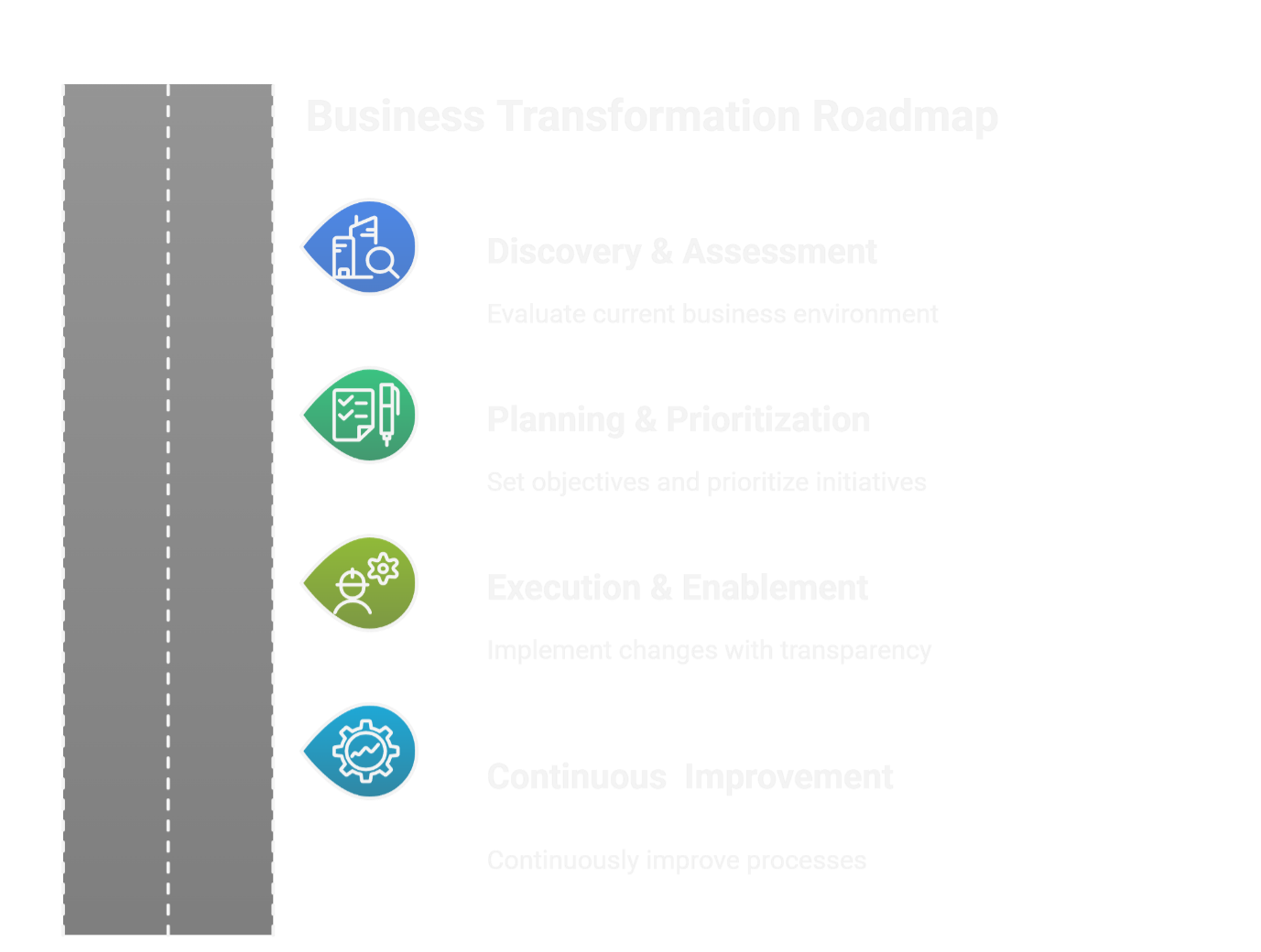
Phase 1 - Discovery and Assessment
Purpose: Assess the business environment in terms of technology usage and organizational structure while considering data aspects well.
Essential SAP Resources:
- SAP Readiness Check Prepares for S/4HANA by assessing system compatibility and readiness.
- Signavio Process Insights & Intelligence employs process mining to uncover inefficiencies.
- LeanIX Visualizing enterprise architecture and dependencies made easy
Ai in Action:
- Investigate system records and user interactions with the help of intelligence to identify areas where processes may be manual or inefficient.
- AI based forecasting, classification, and intelligent decision support in SAP BTP
Phase 2 - Planning & Prioritization
Purpose: Our main aim is to establish the business objectives we want to achieve and then focus on prioritizing the initiatives that will help us reach those goals successfully while ensuring they are aligned with delivering valuable outcomes.
Essential SAP Resources:
- The SAP Transformation Navigator offers tailored recommendations, for SAP products.
- SAP BTP Discovery Center to explore applications use cases, and solutions, on SAP BTP.
- SAP Enterprise Architecture Designer Crafting a blend, between IT infrastructures and business objectives it plays a role in ensuring alignment and synergy.
Ai in Action:
- Engage in creating situations, within SAP Analytics Cloud to predict Return, on Investment (ROI) and evaluate project risks.
- Utilize machine learning to assess the effects of migration routes and automation, on operations.
Phase 3 - Execution and Enablement
Purpose: Carry out the changes gradually while focusing on transparency and control to ensure acceptance.
Essential SAP Resources:
- SAP Activate Saps Implementation Framework
- SAP Cloud ALM Focuses on Managing deployment and operations, in time
- SAP Build Work Zone for workspace organization and workflow coordination.
- SAP Enable Now In-app training and user support
Ai in Action:
- Enhance your workflow using SAP Intelligent RPA for task automation. Introduction, to SAP Robotic Process Automation (RPA)
- Try leveraging SAP Joule, which's SAPs AI copilot for support, in your business operations.
Phase 4 - Continuous Improvement
Purpose: Meticulously observe and improve procedures to enhance lasting efficiency.
Essential SAP Resources:
- SAP Signavio Process Insights Provides real-time metrics and improvement recommendations
- SAP Business Technology Platform (BTP) Foundation for data, AI, and integration
- SAP Datasphere Unified, analytics-ready data layer
Ai in Action:
- Educate machine learning models using SAPs AI Core.
- Utilize SAP Analytics Cloud for forecasting needs and identifying patterns.
Measuring Progress: through Key Performance Indicators in Business Transformation
Effective change needs to be quantifiable to have significance in our work environment and culture cohesion is maintained by establishing performance indicators (KPIs) for everyone, in the team.
Top Metrics, to Monitor:
- Efficiency refers to the number of tasks automated and the time it takes to complete a cycle.
- Adoption rates, for SAP Enable Now. The completion of employee training.
- Customer satisfaction level is measured using the Net Promoter Score. How quickly issues are resolved through SAP CX and Ariba platforms.
- The effects of innovation, on decision making with the help of AI, through Joule or SAC and the acceleration of product launches.
- Is it worth it? Comparing cost savings with the investment, in tools such, as S / 4 HANA or SAP BTP
You can keep track of these performance indicators using SAP Analytics Cloud, SAP Signavio and personalized dashboards, on SAP BTP.
Conslusion
In today's business landscape a business transformation roadmap serves as more, than a blueprint. It forms the operational framework of contemporary enterprise strategies. By leveraging SAPs array of tools such as Signavio and Joule along with data platforms, like SAP BTP and Datasphere companies can transition from scattered initiatives to comprehensive transformational journeys that deliver tangible results.
SAP empowers businesses to not just transform but to thrive by incorporating AI throughout every stage and measuring success using the metrics.
Ready To Transform your Business?
Ready to transform your business and need more information about our conversion accelerator?
Contact with Our Advisor